Bridging Genomics and Tool Development - Dr Jody Phelan's week of scientific exchange in South Africa

Dr Phelan’s research sits at the dynamic intersection of genomics, bioinformatics, and infectious disease research, with a strong focus on supporting global health systems and strengthening capacity globally.
Invited by Dr Emilyn Costa Conceição, Prof Tulio de Oliveira, and Prof Robin Warren, Dr Phelan participated in a series of strategic meetings, lectures, seminars, and both theoretical and practical training sessions.
Development of Access to Genomic Epidemiology
Internationally recognised for his contributions to genomebased surveillance, antimicrobial resistance (AMR) prediction, and the development of open-source computational tools, Dr Phelan has built a career centred on making genomic technologies accessible and useful for public health programmes. Working under the mentorship of Prof Taane Clark within the Department of Infection Biology at the LSHTM, he has been instrumental in advancing analytical methods and tools that empower laboratories and institutions globally to integrate genomics into routine practice.
He is particularly known for:
- Developing bioinformatics tools for detecting drug-resistant mutations in pathogens such as Mycobacterium tuberculosis.
- Conducting studies that combine big data, machine learning, and population genomics.
At the core of his work is a clear mission: to translate complex genomic data into actionable tools that clinicians, laboratories, and national tropical diseases programmes can use to save lives.
Translating Genomics Into Actionable Insights
At CERI’s Technical Working Group Seminar Series, coordinated by Dr Monika Moir, Dr Phelan delivered a presentation titled “Application of Genomics and AI for DrugResistance Profiling in Infectious Diseases”. His seminar set the tone for a week rich in scientific exchange, collaboration, and hands-on training.
He showcased how the integration of whole-genome sequencing, AI-driven predictive algorithms, and epidemiological insights is revolutionising the ability to identify drug-resistance mutations rapidly and accurately. This approach is particularly impactful for tuberculosis (TB), where early identification of resistance is essential for improving patient outcomes and preventing further transmission.
Beyond TB, Dr Phelan demonstrated how the TB-Profiler framework has been adapted for other pathogens, including CovidProfiler and Malaria-Profiler, and highlighted his current interest in the Nontuberculous Mycobacteria (NTM)-Profiler. His presentation sparked thoughtful discussion among researchers and students, highlighting CERI’s role as a hub of innovation and collaborative learning.
Deepening Scientific Collaboration Across Institutions
Beyond the seminar hall, Dr Phelan’s visit was exposed to multiple opportunities for meaningful scientific engagement across Stellenbosch University groups, National Health Laboratory System (NHLS) and University of Western Cape (UWC).
Dr Phelan met with members of the TBG group and the NHLS Green Point pathology team to explore current and future research directions, particularly in the field of NTM. The group discussed a jointly developed project rooted in a codevelopment approach that aims to equitably benefit South Africa and Global South institutions and researchers. This partnership framework strengthens not only scientific impact but also fairness, mutual learning, and North–South collaboration.
Hosted by Peter van Heusden at UWC, Dr Phelan delivered a lecture to a diverse and engaging audience, followed by productive discussions on projects and potential collaborations.
Hands-On Training: Bringing Tools to the Bench and Clinical Interpretation
One of the highlights of the week was Dr Phelan’s full day of inperson genomics training for NHLS pathologists, Sarishna Sigh and Stefan Opperman. The training focused on one of his most widely used tools, TBProfiler, covering:
• How the web tool works (https:// tbdr.lshtm.ac.uk/).
• How to interpret genomic TB drug-resistance profiles using the World Health Organization Catalogue of Mutations.
• How to apply these outputs in clinical and diagnostic practice.
This practical session was particularly well received, building confidence among pathologists in integrating WGS-based tools into routine workflows.
Bioinformatics Troubleshooting With FMHS Colleagues
Dr Phelan also acted as an informal bioinformatics consultant, meeting with around 10 researchers from the Faculty of Medicine and Health Sciences (FMHS). These sessions involved troubleshooting computational challenges, brainstorming new analysis strategies, offering guidance on genomic data interpretation, and sharing best practices for reproducible genomics research.
Participants described these discussions as a “rich experience” that provided clarity, new ideas, and renewed motivation.
A Strong Finish: The Final Seminar of 2025 at the Biomedical Research Institute
To conclude this week in South Africa, Dr Phelan delivered a closing talk during the final and special divisional seminar of
2025 at the Biomedical Research Institute (BMRI), which also featured the introduction of the new Head of Institute, Prof Jean Nachega.
The seminar ended with enthusiasm for expanding shared projects, strengthening partnerships, and continuing to develop tools that serve communities most affected by infectious diseases.
Looking Ahead
Dr Phelan’s visit reaffirmed the importance of open scientific exchange, equitable collaboration, and capacity strengthening in the Global South. His contributions throughout the week, from seminars and training to collaborative project design, will have a lasting impact on TB and NTM genomics research within CERI, TBG, and NHLS.
CERI, TBG and other groups at Stellenbosch University extend their warmest thanks to Dr Jody Phelan for his inspiring visit, and we look forward to building the next chapter of collaborative innovation together.
“At the core of my work is a clear mission: to translate complex genomic data into actionable tools that clinicians, laboratories, and national tropical diseases programmes can use to save lives”
– Dr Jody Phelan
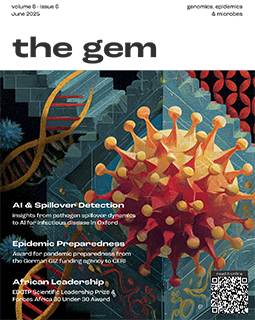
This news piece was published at the gem!

Click on the image above to read the gem, genomics, epidemics & microbes Vol 8 Issue 10, Nov/Dec 2025, or scan the qrcode.
News date: 2025-12-01
Links:
https://issuu.com/the.gem/docs/the_gem_-_genomics_epidemics_microbes_nov_dec_2025/41?fr=xKAE9_zU1NQ