Building Knowledge and Networks with MIT, Harvard and UC Louvain

They came along with members of their research teams. Their week-long visit, from October 27 to 31, marked an important milestone in CERI’s growing leadership in women’s health, microbiome science, and datadriven innovation across Africa.
The multidisciplinary collaboration between our groups focuses on one of the most complex and urgent challenges in reproductive health: understanding how host tissues and microbes interact in the female genital tract. This understanding forms the basis of our current joint projects, supported by the Gates
Foundation, which investigate how live biotherapeutic products (LBPs) might help reshape the environment to reduce inflammation, prevent sexually transmitted infections, and improve long-term health outcomes.
Their visit came at a crucial moment. With data emerging from several of our clinical trials – including the VIBRANT trial, which evaluates multistrain Lactobacillus crispatus LBPs – there is a growing need for robust, standardised, and scalable analytical pipelines that integrate clinical metadata, 16S rRNA sequencing, metagenomics, flow cytometry, cytokine profiling, and metabolomic and proteomic datasets. Laura and Joseph’s expertise in multiomics integration and statistical modelling has been central to shaping these approaches.
A Week of Deep Engagement and Shared Learning
Throughout the week, the teams worked closely with members of CERI and Stellenbosch University, as well as external colleagues from KRISP and CAPRISA. Sessions ranged from handson computational analysis to conceptual discussions on multiomic integration, stratification of microbiome communities, and precision detection of bacterial strains using shotgun metagenomics – key themes captured in their seminar held during the African STARS Seminar series.
A highlight of the visit was a halfday open R workshop at the Biomedical Research Institute (BMRI), where participants from diverse departments not only learned but also actively shared analytical strategies, troubleshooted challenges, and built cross-disciplinary networks that will continue long after the
African STARS Seminar Series: Why This Work Matters
During their visit, Laura and Joseph also delivered a dynamic joint lecture as part of the African STARS seminar series, where they detailed the scientific and clinical significance of our shared research (see link at the end).
Drawing on data from international microbiome studies and the VIBRANT trial, they illustrated how vaginal microbial communities – particularly the presence or absence of Lactobacillus crispatus – shape inflammation, susceptibility to infection, reproductive outcomes, and the likelihood of clearing or sustaining bacterial vaginosis. Their talk highlighted:
• The urgent global need for innovation in treating bacterial vaginosis.
• Emerging evidence for multistrain LBPs as a promising strategy to support healthier genital environments.
• The critical role of multi-omic data integration in understanding mechanisms of engraftment, inflammation, and microbiome dynamics.
• Why African-led, Africa-centred research is essential for progress in women’s health.
The audience responded with enthusiasm, sparking a vibrant question-and-answer session on microbial ecology, partner treatment, global inequities in reproductive health, and the future of LBPs in Africa.
Collaboration as a Catalyst for Capacity Building
This visit was not a one-directional transfer of knowledge; rather, the exchange between SU, CAPRISA, KRISP, MIT, and UC Louvain embodied the principles that underpin impactful science in Africa:
1. Multidisciplinary approaches to complex problems: Reproductive health challenges – such as bacterial vaginosis, HIV susceptibility, and preterm birth – cannot be solved by any single field. This collaboration brings together clinicians, immunologists, microbiologists, statisticians, computational biologists, and engineers to form a unified scientific ecosystem.
2. Data-driven research capacity for Africa’s challenges: By strengthening computational expertise and analytical infrastructure within South Africa, we ensure that African datasets are analysed within Africa, by African scientists, for African women.
3. Networks that amplify impact: Relationships formed during the visit – among students, postdocs, researchers, and visiting teams – lay the foundation for long-term scientific networks that accelerate discovery and empower emerging scientists.
4. Co-creation of knowledge: The integration of insights from this collaborative interaction is advancing new analytical tools, novel research questions, and forward-looking trial designs that reflect the lived realities of women across the continent.
Looking Ahead
CERI looks forward to deepening such fruitful international and interdisciplinary collaborations and continuing to build a vibrant, interconnected research community – one that is committed not only to scientific excellence but also to improving the health and lives of women and communities across Africa.
Seminar recording: https://youtu.be/DcdJEA-HWWo?si=Na-ELvcKEQhjDBsl
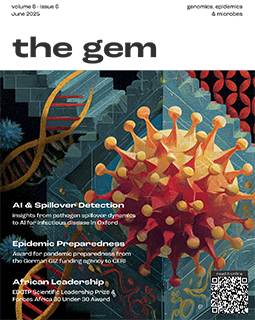
This news piece was published at the gem!

Click on the image above to read the gem, genomics, epidemics & microbes Vol 8 Issue 10, Nov/Dec 2025, or scan the qrcode.
News date: 2025-12-01
Links:
https://issuu.com/the.gem/docs/the_gem_-_genomics_epidemics_microbes_nov_dec_2025/34?fr=xKAE9_zU1NQ