Research Days 2025 - Pioneering solutions for Africa’s most pressing challenges

In his opening address, Prof Kanshukan Rajaratnam, Director of the School for Data Science and Computational Thinking, aligned the event with SU’s broader vision: “We will be Africa’s leading researchintensive university. We want to impact the country and continent.” He highlighted the School’s growing role in advancing AI and interdisciplinary collaboration, adding, “We also aim to enhance our activities in service to society through academic, industrial, and governmental partnerships, workshops, and science communication.”
Reflecting on recent achievements, CERI Director Prof Tulio de Oliveira said, “Transformation happens with excellence. We went from concept to reality.”
He pointed to the new LaunchLab CERIBio as one such accomplishment – “a biotech lab for startups, providing affordable space, equipment, and support to commercialise research” – and emphasised the need to increase public engagement with science: “We must get the science out of the university and to the public. Media coverage, awareness, and engagement are crucial.”
Metagenomics and Poster Pitches
The Day 1 keynote by Dr Erin Harvey explored the global virosphere through metagenomics, demonstrating how this approach allows researchers to study entire viral communities, not only those that can be cultured. She highlighted existing biases in current virome data – geographic, economic, and species-related – and showed how under-sampled hosts, such as marsupials, can reveal critical evolutionary patterns. Her talk underscored the need for broader sampling and more wet-lab validation to fully understand viral diversity.
Students then delivered dynamic poster pitches on a wide range of topics, from therapeutic HPV vaccination and HIV incidence trends in rural KZN to wastewater surveillance of Hepatitis E and polio outbreak risk. The poster session that followed created a lively space for engagement, allowing attendees to exchange ideas, ask questions, and connect with emerging research across the Data School.
Researcher and Student Talks
The afternoon moved into extended presentations, beginning with Prof Frank Tanser, who revealed new evidence that HIV incidence in South Africa is rising again after years of decline and that viral suppression has plateaued – trends that challenge long-held assumptions about progress toward the UNAIDS 2030 targets. Subsequent talks covered climate-sensitive
infectious disease forecasting through the CLIMADE consortium, the ecology and distribution of tsetse flies, shifts in HIV dynamics during the COVID-19 era, and a new Hepatitis Virus Sequence Dashboard that identifies surveillance gaps and drug resistance patterns. These sessions, along with further student presentations and project overviews, set the tone for an evening braai that encouraged collaboration, networking, and communitybuilding.
Data Science Driving Solutions for Africa’s Health Challenges
Day 2 highlighted how data-driven innovation is already transforming health systems and disease control across the continent. Research spanned infectious disease modelling, genomic surveillance, biotechnology, and climate–health analytics, with each contribution offering practical and scalable solutions tailored to African settings.
A major theme was precision health and prevention. Modelling studies demonstrated how optimised HPV vaccination strategies, especially for women living with HIV, could significantly reduce cervical cancer incidence and associated costs. This work supports integrated approaches that combine vaccination, screening, and treatment in pursuit of elimination goals.
Antimicrobial resistance and neonatal survival were also key concerns. With resistance rising and threatening gains in neonatal care, researchers presented tools that use real-world microbiology data to optimise antibiotic prescribing in low-resource hospitals – improving survival rates while limiting unnecessary antibiotic use.
Climate–health interactions emerged as another urgent research frontier. Presentations examined how climatedriven migration shapes dengue transmission and how spatial repellents influence mosquito clustering, generating insights relevant to future vector control strategies.
Biotechnology and genomics featured prominently. Enzyme engineering and biomanufacturing efforts showcased pathways to local production of diagnostics
and therapeutics. Advances in hybridisation capture for metagenomic sequencing demonstrated improved sensitivity and speed, bolstering South Africa’s outbreak detection capabilities. Meanwhile, the REVIGET project showed how genomic epidemiology can strengthen TB surveillance and enable precision treatment for drug-resistant strains.
Artificial intelligence surfaced throughout the programme, particularly in work aimed at reducing bias in large language models to improve fairness, transparency, and interpretability in health analytics.
Across all sessions, a shared message was clear: data science is about impact. By merging modelling, genomics, engineering, and machine learning with public health realities, researchers are building systems that are locally grounded, scalable, and oriented toward saving lives.
“Research Days have been going on since 2007, but this is the first Data School event,” said Faikah Bruce, Training Coordinator at SACEMA. SACEMA Managing Director Lynnmore Scheepers emphasised the importance of the event for young researchers, noting, “It is a great platform for students to connect, share their work, and form a community.” Bruce added that the experience is invaluable for early career scientists: “It is so nice for them to find out who their peers are and what they are working on… This exposes them to what a conference would be like and teaches students how to navigate their careers.”
Closing keynote speaker Jo-Ann Passmore captured the spirit of the event in her message to young scientists: “Your career is an ecosystem, not a ladder… You will never feel ready, and that’s okay. Let your purpose anchor you when everything else wobbles. Build people, not empires. Protect your thinking time. Be unapologetically African in your science.” Her words echoed the motivation behind the research presented throughout the two days – purposeful, resilient, and committed to generating solutions that truly matter.
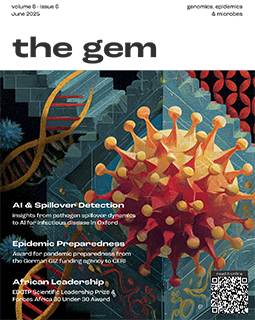
This news piece was published at the gem!

Click on the image above to read the gem, genomics, epidemics & microbes Vol 8 Issue 10, Nov/Dec 2025, or scan the qrcode.
News date: 2025-12-01
Links:
https://issuu.com/the.gem/docs/the_gem_-_genomics_epidemics_microbes_nov_dec_2025/24?fr=xKAE9_zU1NQ