Using Science in Service of Society
At the KwaZulu-Natal Research Innovation and Sequencing Platform (KRISP), the future of African genomics is being shaped by a new generation of scientists whose journeys are as compelling as the research they lead. Though their paths differ, Thembelihle Tombo and Nqobile Mthembu share a common purpose – to use science in service of society. Their stories reflect resilience, faith, quiet determination, and the courage to grow, showing what is possible when talent meets opportunity.
THEMBELIHLE TOMBO
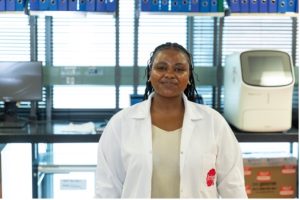
Born in Mpumalanga and raised in Richards Bay, KwaZulu-Natal, Thembelihle Tombo describes herself as naturally quiet and reserved – a trait she now recognises as a strength. “People sometimes mistake quietness for weakness,” she reflects, “but I have come to understand that it can also be a form of strength.”
Like many students, she excelled at school without full exposure to career possibilities. What she did know was that she wanted to make a difference. That purpose took shape when she began to see science not just as an academic pursuit, but as a tool for impact.
At university, representation played a pivotal role.
“Seeing women in science changed the way I viewed the field,” she says. “I had imagined science as a difficult and lonely path, but I met women who were hardworking, confident, and full of life.” Among those who inspired her was Dr Yanga Mdleleni, whose example helped her see that she belonged.
Her path into genomics and medical research brought uncertainty, self-doubt, and social anxiety. With support from her supervisors, the KRISP team, and her family, she found her footing. “What helped me was staying committed, working hard, and leaning on the people who believed in me – even when I struggled to believe in myself.”
Thembelihle’s MSc research, completed cum laude, focused on making sequencing more accessible. Titled Evaluation of a single assay for surveillance of multiple viral pathogens using Next Generation Sequencing, it explored whether lower-cost approaches could still deliver high-quality results when detecting multiple viruses. In simple terms: can we do more with less – without compromising quality?
The implications are significant. In resource-limited settings, where sequencing costs are a barrier, even small efficiencies can expand access to genomic surveillance tools. “This research is important because affordable genomic surveillance supports better monitoring of viruses and stronger public health responses,” she explains. “If we can reduce costs, more laboratories can generate the data needed to protect communities.”
Learning she had graduated cum laude came as a surprise. “Honestly, I was in disbelief,” she says. “It felt unreal because I knew how difficult the journey had been.” More than an academic milestone, it marked a turning point: “It helped me start letting go of self-doubt. Hard work – even when it feels unseen – can lead to something meaningful.”
Now pursuing her PhD at KRISP, she is focused on deepening her research and impact. “I want to become a researcher who makes a tangible difference in people’s lives,” she says. She also hopes to inspire others who may doubt they belong in science. “I want to show that there is space in science for people with different personalities, backgrounds, and voices.”
Her story carries a message beyond the lab: “Being quiet does not mean you have nothing to offer. Sometimes strength is not loud.” Guided by humility and perseverance, she holds onto the lesson: “I try, I fail, but at least I never failed to try,” alongside the Zulu proverb Ophansi akawi.
Thembelihle’s journey shows that impact does not always begin with confidence – sometimes it begins quietly, with the courage to keep going.
NQOBILE MTHEMBU

Raised in Pietermaritzburg, Nqobile Mthembu ’s path into science was shaped by both academic ability and a desire to contribute to something greater than herself. Her time at UKZN was formative.
“My interest in science grew through my exposure to women in science,” she reflects. “Seeing women thrive made me believe that I, too, could contribute in a meaningful way.” Inspired by mentors such as Dr Danisile Tembe and Dr Yanga Mdleleni, she came to see science as a space where she could belong – and make a difference.
Like many young researchers, she had to step into unfamiliar spaces. “One of the biggest challenges has been stepping into new spaces,” she says. “I learned to overcome that by being patient, staying committed, and trusting the process.”
Drawn to KRISP through its role in COVID-19 genomics, she entered an environment where innovation meets real-world impact.
Her Master’s research, completed cum laude, focused on using existing resources more effectively. Titled Advancing Genomic Surveillance: A Single Streamlined Next-Generation Sequencing Approach for South Africa’s Common Respiratory Viruses, it explored how COVID-19 sequencing infrastructure could be repurposed to monitor other respiratory viruses. In simple terms: how can we extend the life and value of the tools we already have?
“This work is about affordability and accessibility,” she explains. “Many laboratories have COVID-19 sequencing infrastructure, but not all know how to use it beyond the pandemic.” The implications are significant, especially in resource-limited settings. “If we can repurpose existing infrastructure, we can continue generating valuable public health data without needing entirely new systems.”
When she graduated cum laude, the moment was deeply emotional. “I felt incredibly happy, grateful, and relieved,” she recalls. “It reflected the early mornings, late nights, prayers, and perseverance.” It also affirmed her confidence in contributing meaningfully to science.
Looking ahead, she is guided by both ambition and purpose. “I want to be part of work that makes genomic technologies more accessible… Science should not only be innovative – it should be practical and useful.”
Nqobile draws strength from her family, friends, church community, and faith. Proverbs 16:9 – “We can make our plans, but the Lord determines our steps” – has helped her navigate uncertainty with trust. “It reminds me to work hard, but also to stay open to where life leads.”
She values balance and encourages young women entering science: “Work hard, believe in your ability, and do not be afraid to take up space… but do not lose yourself in the process.”
Her definition of success reflects this: “Growing into the fullest version of yourself, using your gifts well, and making an impact while staying true to who you are.”
Nqobile’s journey reflects a strong sense of purpose and commitment to science that serves society.
News date: 2026-04-09
Links: